
OT Data Platform
for OT and IT Teams
Proxus gives OT and IT teams an OT data platform within a broader industrial data platform that collects from plant-floor assets, normalizes operational context, stores history, and routes governed data to dashboards, MES, ERP, data lakes, and AI workflows without rebuilding the stack for every new consumer.
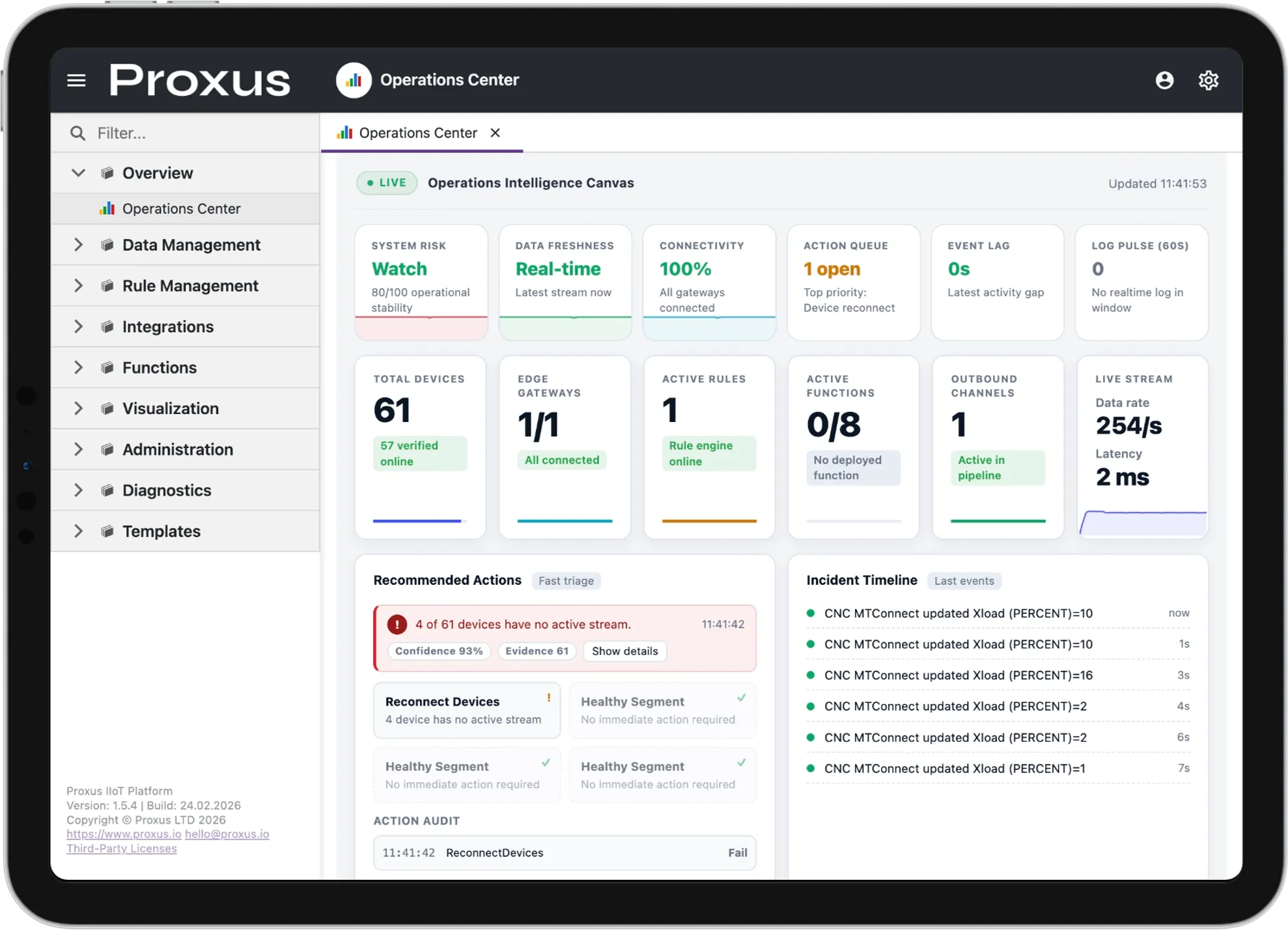
What an industrial data platform should solve
Most organizations do not have a lack of data. They have a lack of structure, ownership, and reusable delivery patterns. An industrial data platform should turn fragmented tags, historians, and point integrations into one governed operating layer. For OT teams, that means reliable plant context. For IT teams, it means a reusable operational data platform with stable contracts.
- hub Collect once from PLCs, sensors, meters, and industrial systems.
- schema Normalize context into a stable model, not raw device-specific paths.
- sync_alt Route anywhere to dashboards, storage, MES, ERP, APIs, and AI consumers.
Core platform layers
One industrial data flow from asset to business system
The platform becomes valuable when new consumers do not require a fresh integration project. Proxus organizes the flow so every new dashboard, report, data export, or AI use case builds on the same foundation.
Acquire data from OT systems with edge-local resilience and protocol coverage.
Map raw signals into an operational hierarchy with stable naming and ownership.
Store live and historical context for trend analysis, compliance, and advanced analytics.
Serve dashboards, IT systems, data exports, and AI workflows from the same governed layer.
Designed for both OT and IT ownership
OT teams need trustworthy plant context and resilient collection. IT teams need stable data contracts, routing patterns, and controlled access. Proxus gives both sides a shared platform without forcing every requirement into the same tool.
Protect field connectivity, keep execution close to the process, and expose data without opening inbound control paths.
Consume governed operational data through stable topics, connectors, APIs, and storage layers instead of custom driver logic.
High-value outcomes
- Real-time operations dashboards with historical context
- MES and ERP exports without duplicating OT integration work
- Energy, quality, and downtime analytics from one model
- Long-term retention through industrial storage
- Secure fan-out through IT/OT integration flows
FAQ
Questions teams ask when evaluating an industrial data platform for real-world operations.
It is the governed layer that collects OT data, adds operational context, stores history, and delivers clean data to dashboards, enterprise systems, and AI workflows.
No. A historian is one component. The broader platform covers collection, normalization, routing, storage, dashboards, and downstream consumers.
No. The platform sits between OT data sources and data consumers so legacy systems can stay in place while new use cases are added incrementally.
Yes. That is the point of the shared model. Dashboards, storage, and enterprise connectors all build on the same governed data layer.
OT DataOps describes the operating discipline. Proxus provides the platform layer that applies those patterns across collection, modeling, routing, retention, and governance.
Technical and Commercial Evaluation
OT Data Platform evaluation guide
Operational problem it addresses
Plant data is usually trapped in device-specific tags, isolated historians, and one-off integrations. The platform creates a reusable operational layer so each dashboard, MES, ERP, analytics, or AI initiative does not need to rebuild collection and context from the source.
Data sources it connects
- PLCs, RTUs, sensors, meters, and edge devices
- SCADA, existing historians, OPC UA servers, and MQTT brokers
- MES, quality, maintenance, and other operational systems
How the data is processed
- 1.Collect data through governed industrial connections.
- 2.Normalize names, units, timestamps, and asset context into a reusable model.
- 3.Retain live and historical data according to the configured storage and retention policy.
- 4.Deliver governed data to operational and enterprise consumers without changing the source contract for every project.
Edge and outage behavior
Edge nodes can continue supported local collection and processing when the central connection is unavailable. Replay depends on configured buffering capacity, retention, outage duration, connector acknowledgements, and target-system health; it is not an unconditional zero-loss guarantee.
Systems that consume the data
- Dashboards
- MES
- ERP
- CMMS
- BI
- Data lakes
- APIs
- AI workflows
Security and deployment boundary
Proxus can run in customer-controlled infrastructure. Network zones, identities, certificates, roles, outbound targets, retention, and remote access remain deployment decisions that must be reviewed with the customer's OT and IT security owners.
Technical validation and next step
When it is a good fit
- Multiple consumers need the same contextualized OT data.
- Brownfield and modern assets must participate in one governed model.
- The organization needs local operation with controlled enterprise delivery.
When it is not a good fit
- The requirement is only a temporary point-to-point copy between two systems.
- Safety-critical closed-loop control is expected to move out of the PLC or safety system.
- The project has no owner for asset modeling, governance, or lifecycle maintenance.
Evaluation FAQ
Is an OT data platform the same as an IIoT platform?
IIoT connectivity is one part of the scope. An OT data platform also governs context, historical storage, delivery contracts, ownership, and reuse across operational and enterprise consumers.
Does Proxus require a cloud deployment?
No. Proxus supports customer-controlled deployment. The final topology, remote access model, and external services depend on the selected architecture and integrations.
Can it replace every existing historian or integration tool?
Not automatically. Migration should be evaluated by data volume, retention, query behavior, connector requirements, validation needs, and the operational risk of replacing an established system.