
Industrial Edge Platform
for Reliable Plant-Floor Data
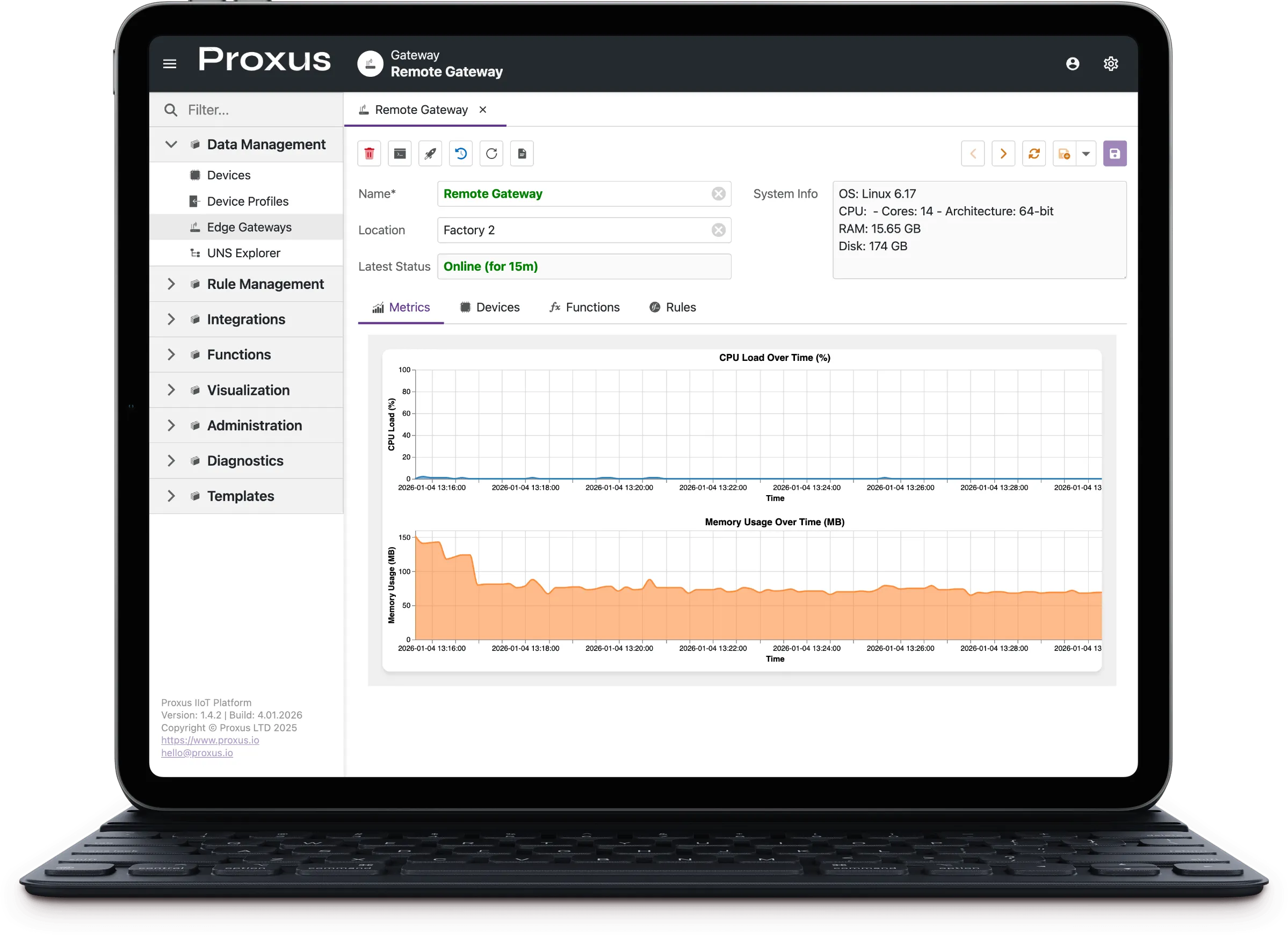
Proxus gives you an industrial edge platform that runs protocol drivers, buffering, local rules, edge data collection, and secure outbound delivery close to the process. During network interruptions, behavior depends on buffer capacity, outage duration, traffic, and connector acknowledgements before governed data is recovered upstream.
Why teams evaluate an industrial edge platform
Most plants do not need more cloud promises. They need resilient local execution. An industrial edge platform should collect from heterogeneous assets, continue operating when WAN links fail, apply store-and-forward patterns, and expose a controlled handoff into brokers, dashboards, and enterprise systems.
- done Keep collection close to the process so plant-floor dependencies stay local.
- done Protect continuity during outages with buffering, replay, and local execution.
- done Standardize handoff upstream into governed topics, storage, and IT integrations.
What belongs at the edge
Four capabilities that turn gateways into a real platform
An industrial edge platform is not a single connector or a one-off gateway image. It becomes valuable when the same operating model can be reused across lines, sites, and different protocol mixes.
Acquire plant-floor data from OPC UA, Modbus, Siemens S7, meters, and industrial software systems.
Persist telemetry locally so reconnects do not create blind spots or force data-loss trade-offs.
Run local rules, filtering, and threshold logic before traffic reaches shared infrastructure.
Publish governed streams upstream when links are available and consumers are ready.
From single gateway to repeatable fleet rollout
Edge architecture fails when every site becomes a custom snowflake. Proxus helps standardize the deployment pattern so teams can reuse driver templates, rules, outbound mappings, and monitoring conventions across many installations.
Connect one line, validate collection and buffering, then expand the same model without re-architecting.
Promote a shared architecture across plants while keeping local variations in configuration, not code forks.
Typical operating patterns
- cloud_off Store-and-forward protects historical continuity during WAN or broker outages.
- rule Local rule execution keeps alerts, thresholds, and event routing close to the process.
- shield Outbound-only delivery reduces inbound exposure for OT networks.
- monitoring Central observability shows connection health, replay lag, and fleet status.
How it fits the broader industrial architecture
The edge layer is most effective when it plugs into a repeatable upstream model rather than becoming a local dead end.
Protocol translation
Bridge local OT protocols through an OPC UA to MQTT gateway when enterprise consumers need a topic-based delivery path.
Shared data layer
Feed edge-collected telemetry into an industrial data platform for storage, dashboards, and downstream integrations.
Secure delivery to IT
Use controlled IT/OT routing patterns to move governed operational data beyond the site boundary.
FAQ
Common questions teams ask when evaluating an industrial edge platform for real plant-floor operations.
Edge computing is one capability inside the broader platform. The platform also covers protocol connectivity, buffering, rollout repeatability, governance, and upstream delivery patterns.
No. Deterministic and safety-critical control should remain in PLC or Safety PLC boundaries. The edge layer handles data acquisition, local logic, buffering, and secure delivery.
It becomes valuable when you have multiple assets, unreliable WAN paths, multi-site rollout goals, or a need to standardize how OT data reaches IT and analytics consumers.
Technical and Commercial Evaluation
Industrial Edge Platform evaluation guide
Operational problem it addresses
A collection of independent gateways becomes difficult to secure, configure, observe, and update across sites. An industrial edge platform standardizes how local connections, context, buffering, rules, and outbound delivery are deployed and operated as a fleet.
Data sources it connects
- PLCs, RTUs, robots, sensors, meters, and OEM equipment
- Local OPC UA, Modbus, S7, MQTT, and supported industrial endpoints
- Site systems that provide asset, production, quality, or maintenance context
How the data is processed
- 1.Deploy a site-approved edge node and establish governed source connections.
- 2.Normalize local signals and apply the site or enterprise asset model.
- 3.Run supported rules, buffering, and local visualization close to the process.
- 4.Deliver selected operational data to central Proxus services and approved enterprise targets.
Edge and outage behavior
Supported local collection, rules, and dashboards can continue without the central connection. Buffered replay is bounded by disk capacity, retention, write rate, connector acknowledgements, and outage duration. Fleet configuration changes should follow staged rollout and rollback procedures.
Systems that consume the data
- Local operators
- Central operations
- UNS
- Historian
- MES
- ERP
- Data platforms
- Remote support
Security and deployment boundary
Edge nodes remain inside customer-controlled network zones. Source credentials, certificates, local accounts, outbound destinations, software updates, remote support, and firewall rules must follow site security ownership and change-control procedures.
Technical validation and next step
When it is a good fit
- Several sites need a repeatable collection and delivery pattern.
- Operations must continue locally during central-network interruptions.
- Gateway configuration, health, and lifecycle need central governance.
When it is not a good fit
- Only one temporary sensor feed is required with no lifecycle needs.
- The edge node is expected to replace PLC or safety control.
- Remote access and update ownership cannot be defined for the sites.
Evaluation FAQ
How is an industrial edge platform different from an edge gateway?
A gateway connects and forwards data. A platform adds repeatable configuration, context, local execution, buffering, health visibility, governance, and lifecycle practices across a fleet of gateways.
Can sites operate when the central connection is unavailable?
Supported local collection, rules, and dashboards can continue, but exact behavior depends on the deployed components, local dependencies, configured capacity, and site architecture.
How should a multi-site rollout begin?
Start with a representative site, define source and asset contracts, test outage and recovery behavior, document rollback, then promote the validated configuration through controlled rollout groups.