
Dec 30, 2025 · 6 min read
Methodology notes
What is Smart Filtering in Edge Computing?
Smart filtering at the industrial edge: how deadbands, aggregation, and event selection control data volume without hiding operational evidence.
- Evidence level: Medium (field observations + public standards; not a universal benchmark).
- Measurement scope: Performance and economic outcomes vary by hardware, topology, workload shape, sampling profile, and process constraints.
- Primary references: IEC 62443-2-1, ISA-95 / IEC 62264, NIST SP 800-82r3.
- Implementation docs: Edge Architecture and Unified Namespace.
The Cloud Ingress Trap
Industrial IoT projects often begin by forwarding every available signal upstream. That approach may be appropriate for a bounded diagnostic capture, but continuous operation can create avoidable network, storage, and query load.
The engineering question is not whether cloud or central processing is useful. It is which detail must cross the site boundary, which evidence must remain available locally, and which events require immediate delivery.
Signal volume depends on tag count, sampling interval, change frequency, payload shape, and retention policy. Before filtering, teams should measure these characteristics and classify the evidence needed for operations, troubleshooting, compliance, and model development.
This is why modern industrial architectures rely on Smart Filtering at the edge.
Observed performance depends on workload shape, node capacity, and deployment design.
What is Smart Filtering?
Smart Filtering (often coupled with Edge Analytics) is the process of examining, reducing, and aggregating raw machine data before it leaves the physical factory building.
Instead of treating the edge gateway as a transparent relay, smart filtering applies an explicit policy to each signal: transmit the sample, aggregate it, retain it locally, or create an event window.
The policy must also define maximum reporting intervals, quality changes, exceptions, audit retention, and recovery behavior. Filtering without these controls can hide the evidence needed for diagnosis.
High-Freq Sensor
10ms Sampling
Proxus Edge
Smart Filter & Deadband
Cloud Storage
Optimized Data
How smart filtering changes data volume
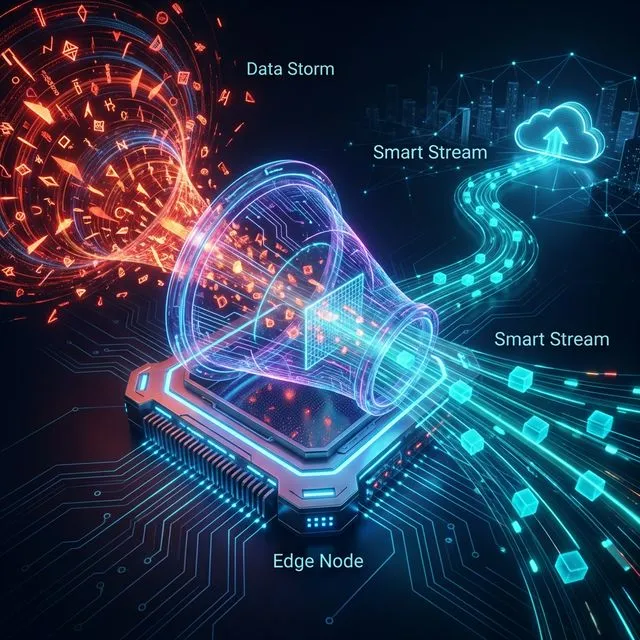
A proper edge computing platform employs three primary filtering strategies to convert a massive "Data Storm" into a highly optimized "Smart Stream":
Deadbanding (Change-of-State)
In many industrial processes, a value doesn’t change for hours. Why send a temperature reading of 72°C every second for a straight hour? With deadbanding, the edge gateway sends a new payload when a value changes by a configured percentage or absolute amount, or when a maximum reporting interval expires. The reduction depends on signal variability, polling frequency, threshold choice, and the events that must remain observable; it must be measured on representative process data.
Time-Based Aggregation
Sometimes, you don't care about the microsecond fluctuations; you just want the trend. For example, an edge gateway may collect readings over a defined window, calculate average, minimum, maximum, and sample count, then send the aggregate with its time boundary and quality. Aggregation reduces resolution; it does not preserve every transient.
The most advanced form of filtering. The Edge Gateway runs continuous localized logic (such as a local Rule Engine). It monitors a high-speed vibration sensor on the local network and can avoid routine cloud transmission until the vibration crosses a warning threshold. Then it streams high-resolution data surrounding the anomaly to the cloud for deeper analysis.
The Proxus Approach to Edge Filtering
At Proxus, we recognize that Edge Computing is fundamentally an exercise in bandwidth and cost optimization.
When you deploy a Proxus Edge Gateway, it isn't just a protocol converter; it is a full Local Rule Engine. From the central Proxus Platform, you can deploy orchestration configurations down to the Edge Gateway. Without writing a single line of custom Python code, you can use built-in functions to:
- Normalize tags (converting raw PLC registers into clean JSON).
- Apply Deadbands (Absolute and Percentage).
- Buffer selected data within configured capacity and retention limits during outages.
- Route critical alarms to local factory sirens, while routing aggregated metrics to the cloud.
Compare raw and filtered streams over the same representative window, replay critical events, and assess the operational effect of lost resolution. Results are specific to the site, signal, and connection profile.
Conclusion
Smart filtering can control upstream load by processing data close to its source. Every filter is also an information-loss decision, so raw retention, aggregation, event windows, and delivery policies must be designed together and verified. In Proxus, this capability belongs to the edge data pipeline of the Industrial Data Platform.
When this may not be suitable
- Lower-frequency telemetry may not justify full distributed complexity.
- Small single-line plants may prefer simpler architectures first.
- Strict legacy constraints may require phased adoption.
- Safety-critical closed-loop control should remain in PLC/Safety PLC layers.
Outcomes depend on workload profile, hardware capacity, and deployment topology.
Frequently Asked Questions
Won't filtering discard data I might need later?
It can. A deadband or aggregate intentionally removes resolution. Configure exception reporting, maximum intervals, quality-change handling, and raw retention according to each signal's operational and audit requirements. Validate the result with known events before production rollout.
What is a deadband and how do I set it?
A deadband defines the minimum change threshold before a new value is transmitted. For a temperature sensor with ±0.5°C accuracy, a 1°C deadband is sensible - changes smaller than sensor accuracy are noise. For vibration monitoring used in predictive maintenance, use much tighter deadbands (or none) to capture high-frequency patterns.
How does Smart Filtering interact with Store and Forward?
They work in sequence: Smart Filtering reduces the volume of data generated, Store and Forward ensures the delivery of the remaining data during outages. Together they minimize both bandwidth costs and data loss risk.
References
- OPC UA Part 8 (Data Access) - Defines deadband filtering for analog items, the standard model adapted by many edge platforms.
- ISA-95 / IEC 62264 - Provides the data categorization framework for determining which data to filter vs. preserve.