
Oct 28, 2025 · 9 min read
Methodology notes
Unified Namespace for IIoT: Architecture and Operational Considerations
Why modern factories need a Unified Namespace (UNS) and how Proxus turns scattered OT data into a single, queryable source of truth. Learn ISA-95 hierarchies, Sparkplug B, and real-world implementation strategies.
- Evidence level: Medium (field observations + public standards; not a universal benchmark).
- Measurement scope: Performance and economic outcomes vary by hardware, topology, workload shape, sampling profile, and process constraints.
- Primary references: IEC 62443-2-1, ISA-95 / IEC 62264, NIST SP 800-82r3.
- Implementation docs: Edge Architecture and Unified Namespace.
For many industrial organizations, Operational Technology (OT) data lives in disconnected silos:
- Legacy PLCs trapped behind proprietary serial protocols.
- SCADA systems tightly coupled to specific HMIs.
- Historian databases that require a PhD in SQL to query.
- Ad-hoc, brittle integrations patched directly into ERP/MES platforms.
The result is often a fragile spaghetti architecture. In that environment, every new integration project tends to increase maintenance effort, naming inconsistency, and change risk more than teams expect.
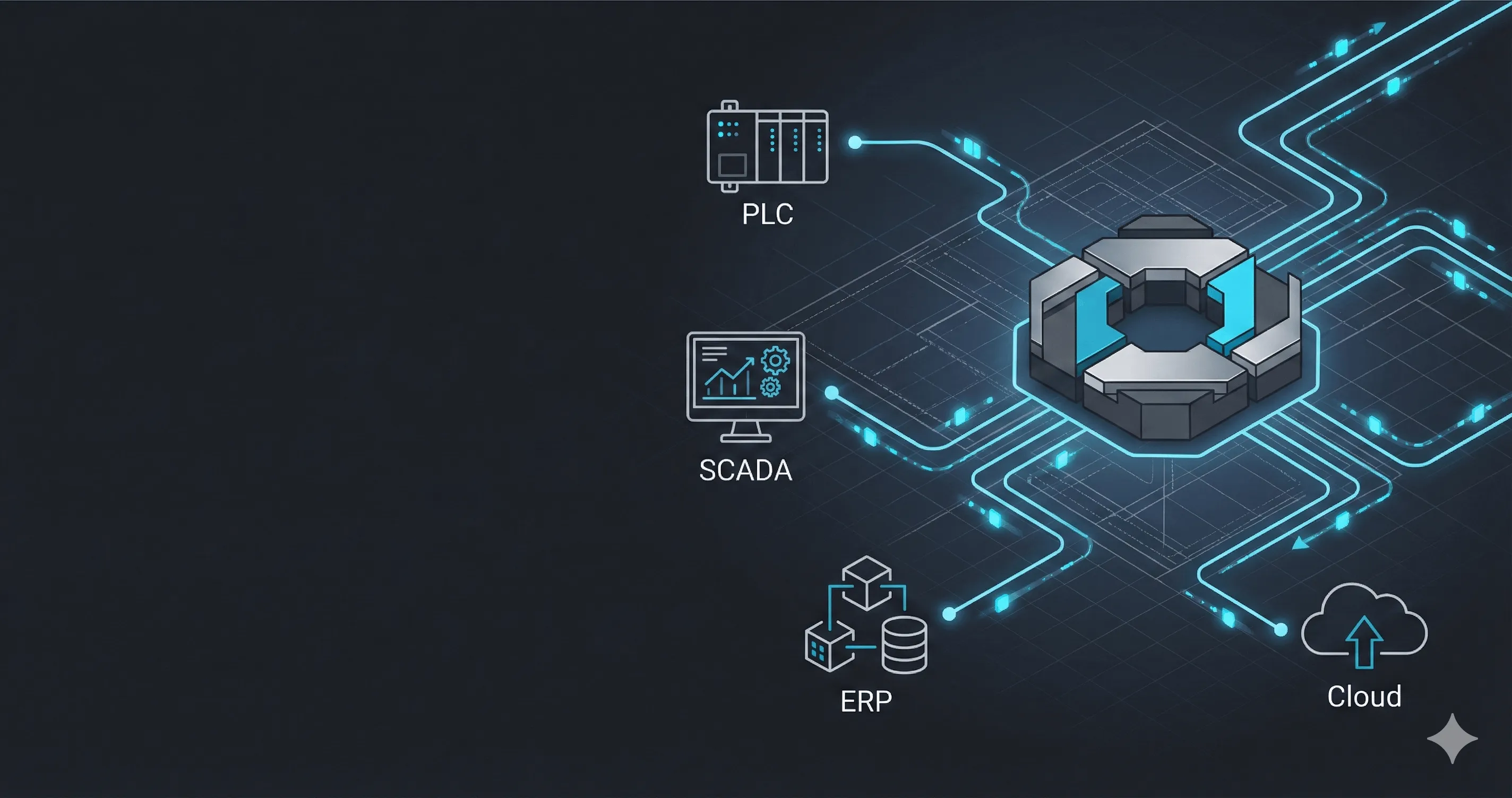
Proxus approaches this fundamental problem differently: by placing a Unified Namespace (UNS) at the absolute center of the architecture. If you are evaluating this as a production software layer rather than only an architecture pattern, see the Proxus Unified Namespace software page.
Observed performance depends on workload shape, node capacity, and deployment design.
What is a Unified Namespace?
A Unified Namespace is not a piece of software you buy; it is an architectural design pattern. In production, that pattern still needs software for connectivity, topic governance, permissions, buffering, history, and observability. It dictates that all operational data flows through a single, well-structured central broker.
In a UNS architecture:
- Every data point has a predictable, semantic location (the MQTT topic path).
- Naming is rigidly consistent across the entire enterprise, usually inspired by ISA-95.
- All consuming systems see the exact same view of the factory without requiring custom data mappings.
Instead of building N × M point-to-point connections (where adding one new software system requires connecting it individually to 30 existing machines), each component acts independently:
- It Publishes what it produces to the UNS.
- It Subscribes only to the payload branches it needs from the UNS.
This topology breaks down data silos, significantly reduces integration friction, and creates an environment where adding a new predictive maintenance algorithm or an ERP bridge is much simpler.
Why MQTT?
MQTT (Message Queuing Telemetry Transport) is the commonly preferred transport protocol for UNS implementations because it inherently:
- Minimizes bandwidth: Devices publish only when data changes (Report-by-Exception), not by continuously polling static values.
- Ensures reliability: Persistent Quality of Service (QoS) queues help prevent data loss during network blips.
- Scales predictably: Modern brokers can support very large topic and subscriber counts when sizing, payload discipline, and downstream consumers are designed appropriately.
- Enforces security: It operates on outbound connections with built-in TLS encryption and strict Access Control Lists (ACLs).
The MQTT broker transports messages between publishers and subscribers. A usable UNS additionally requires governed topic ownership, asset identity, schemas, quality, authorization, lifecycle rules, and consumer contracts.
The ISA-95 Hierarchy: Standardized Data Organization
Proxus_Global
Istanbul_Factory
Assembly_Line_1
Robot_Arm_04
Topic: .../metrics/OEE
Proxus implements UNS natively using the ISA-95 Part 2 hierarchy, which organizes production data into an intuitive five-level pyramid:
Enterprise (e.g., "Proxus_Global")
 └─ Site (e.g., "Istanbul_Factory")
 └─ Area (e.g., "Assembly_Line_1")
 └─ Equipment (e.g., "Robot_Arm_04")
 └─ Metrics (e.g., "Temperature", "Status", "OEE")
This structure ensures that:
- Humans can navigate the data tree intuitively without constantly referring to variable mapping spreadsheets.
- Wildcard subscriptions reduce consumer-specific mappings: A consumer can subscribe to a governed topic pattern such as
Istanbul_Factory/Assembly_Line_1/+/+/OEE. New equipment becomes discoverable through that pattern only when it follows the approved namespace, payload, identity, and access-control contract. - Context is preserved: The topic path itself exposes where the data originated. An anonymous value
72means nothing;Istanbul/Line1/Oven/metrics/Temperature = 72means everything. - Legacy systems adapt: A 25-year-old serial PLC is simply wrapped by a gateway and becomes just another standard "Equipment" node.
A Concrete Example
In a beverage bottling plant, your topics look like this:
ProxusMfg/Istanbul/Bottling/Line3/FillerMachine/metrics/Temperature
ProxusMfg/Istanbul/Bottling/Line3/FillerMachine/state/Running
ProxusMfg/Istanbul/Bottling/Line3/FillerMachine/events/MaintenanceAlert
Sparkplug B: Standardizing Payloads
While MQTT provides the network transport, Sparkplug B is an eclipse specification that standardizes the format of the messages published to MQTT.
It solves a critical "Tower of Babel" problem: without Sparkplug B, one device might publish {"temp": 24} as JSON, while another publishes 24.0 as raw bytes.
Sparkplug B enforces rigid rules:
Birth & Death Certificates
- When an edge device powers on, it publishes a BIRTH message containing its entire schema: all available metrics, data types, and properties.
- In Sparkplug-aware designs, a node can publish lifecycle state and configure an MQTT Last Will message so an unexpected disconnect is represented to subscribers.
- Consumers must still implement session, timeout, retained-state, rebirth, and stale-data handling correctly; a broker does not infer machine health on its own.
Type Safety & Compression
- Sparkplug B mandates the use of Protocol Buffers (Google's binary serialization format) instead of text-heavy JSON.
- It can reduce payload size substantially compared with text-heavy formats, which matters on bandwidth-constrained remote links.
- It enforces schema validation (ensuring a temperature value arrives as a Float, not a String).
Proxus natively supports standard JSON MQTT alongside raw Sparkplug B, allowing you to seamlessly mix legacy polling with modern, event-driven architectures.
How Proxus Executes the UNS
Proxus is built from the ground up to serve as the heart of a UNS. Unlike bolting an open-source MQTT broker onto legacy SCADA, Proxus uses a highly-concurrent actor-based architecture:
Edge Gateways
Proxus field nodes connect supported legacy and modern equipment through configured fieldbus protocols such as Modbus, Siemens S7, EtherNet/IP, and OPC UA. Local state, buffering, credentials, and deployment configuration mean these nodes should not be treated as universally stateless.
Normalization
Each Edge Gateway translates raw integer tags into semantic ISA-95 topics and buffers them to the central UNS broker.
Central Broker Distribution
The central broker distributes live telemetry to subscribed SCADA clients, MES tracking modules, and analytics tools.
Background Persistence
A hidden data pipeline taps into the broker stream and persists historical telemetry to Time-Series engines (like ClickHouse) without introducing transactional latency to the live broker.
Dashboards and Rules
The Proxus Rule Engine evaluates conditions directly off the live topic stream, publishing derived metrics (like OEE anomalies) back into the namespace for UI dashboards to consume.
This architecture is intended to keep live distribution, buffering, and downstream consumption separated so they can scale more cleanly than point-to-point integration patterns.
Real-World Example: Fixing the Spaghetti
Let's look at ProxusMfg's Istanbul bottling facility. They needed to monitor three distinct lines in real-time and correlate line-wide OEE.
Before UNS (The Chaos)
- Siemens S7-1200 PLCs on each line talked to isolated local HMIs over Profinet.
- The MES system polled each PLC directly every 10 seconds via a custom driver.
- The ERP (SAP) ran a batch job every 15 minutes to pull the MES database.
- BI dashboards queried a heavily delayed SAP data warehouse.
- The Bottleneck: Adding a new predictive-maintenance consumer required another source-specific mapping, security review, and deployment change.
After UNS with Proxus
- Three Proxus Edge Gateways wrap the S7 PLCs. They publish normalized data directly to the central Proxus MQTT engine.
- The MES drops its custom polling driver and simply subscribes to
ProxusMfg/Istanbul/Bottling/+/+/metrics/OEE. - The ERP publishes real-time production orders to
ProxusMfg/Istanbul/Bottling/+/commands/ProductionOrder. - The specific Predictive AI Tool subscribes only to vibration and current topics, analyzes them, and publishes anomalies right back to
ProxusMfg/.../events/Anomaly.
Result: The new AI consumer could be added largely through configuration rather than a fresh round of custom point-to-point integration work.
Why Teams Adopt UNS
The Unified Namespace is best treated as a data-distribution pattern, not a slogan. Its value comes from making operational data easier to reuse across systems without rebuilding the same integration path for each new consumer.
Building a UNS still requires governance, naming discipline, and careful rollout. Proxus is designed to handle much of the implementation surface: physical connectivity, payload handling, edge buffering, and central distribution.
When this may not be suitable
- Lower-frequency telemetry may not justify full distributed complexity.
- Small single-line plants may prefer simpler architectures first.
- Strict legacy constraints may require phased adoption.
- Safety-critical closed-loop control should remain in PLC/Safety PLC layers.
Outcomes depend on workload profile, hardware capacity, and deployment topology.
Frequently Asked Questions
What is the difference between this article and the UNS Architecture Guide?
This article explains the concept of UNS - why it exists, how it differs from the Automation Pyramid, and what business value it delivers. The Architect's Guide to UNS is the implementation blueprint - MQTT topology, ISA-95 namespace design, Sparkplug B payloads, and a 5-phase rollout roadmap.
Can UNS work with OPC UA?
Yes. UNS does not replace OPC UA - it complements it. OPC UA excels at local machine-to-machine reads; MQTT excels at scalable pub/sub distribution. Edge Gateways read via OPC UA and publish to the UNS via MQTT.
How do I handle data quality in a UNS?
Use Smart Filtering at the edge to eliminate noise before data enters the UNS, and enforce strict topic naming governance. The OT DataOps pipeline ensures data is clean, contextualized, and semantically consistent across all consumers.
To evaluate how this topic fits into a customer-controlled operational data architecture, review the Proxus Industrial Data Platform and the implementation documentation linked above.
References
- ISA-95 (IEC 62264) - Enterprise-control integration standard defining the hierarchical model adapted for UNS topic design. ISA-95
- MQTT v5.0 OASIS Standard - Publish-subscribe protocol serving as the UNS transport layer. mqtt.org
- Eclipse Sparkplug Specification - Payload standardization for MQTT-based IIoT interoperability. sparkplug.eclipse.org
Learn how to implement these patterns physically by exploring our Edge Computing Patterns or dive into the technical details in the Core Concepts Guide.