
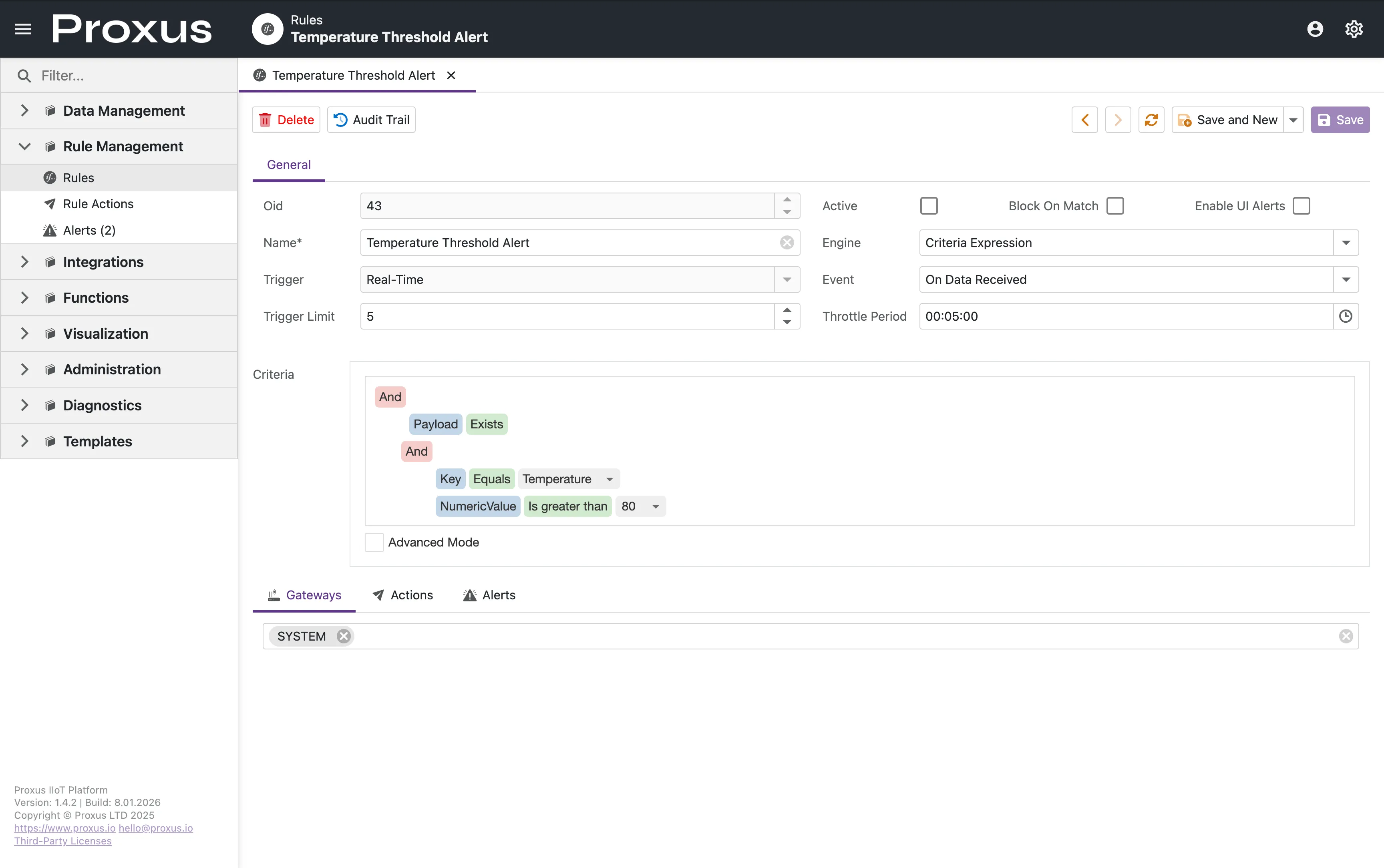
The Rules Engine is the brain of the Proxus platform. It allows you to define complex conditions that are evaluated against every single data packet coming from your devices.
Evaluation Modes
Proxus supports multiple ways to define rule logic, catering to different industrial use cases:
Visual Rules Engine
Build boolean logic trees using a drag-and-drop interface.
Expression Syntax
Write advanced SQL-like expressions for complex multi-tag derivations.
Anomaly Detection
Detect deviations from normal operating behavior using statistical models.
Runtime Flow
Real-Time Pipeline
Rules are evaluated on the active gateway data path before matching actions are dispatched. This lets Proxus filter, prioritize, alert, or route data while telemetry continues to flow to storage.
Fieldbus Data
PLC / Sensor
Gateway Pipeline
Edge Runtime
Rules Engine
Evaluate Criteria
Database
Persist Data
Actions
Alert / Notify
Stateful vs Stateless
While most rules are stateless (evaluating the current packet), anomaly detection and complex expressions can utilize time-windowed buffers to detect trends and rolling averages.
Key Capabilities
- Data Filtering: Use "Block on Match" to prevent sensor noise from reaching your database.
- High Priority Routing: Force critical events to bypass standard queues and reach operators instantly.
- Derived Tags: Calculate efficiency (OEE) or virtual metrics on the fly by combining data from multiple sensors.
- Outbound Connectors: Trigger outbound channels such as MQTT, Kafka, HTTP, or cloud IoT targets when a rule matches. See Outbound Connectors.
- Anomaly candidates: Review spike, drift, flatline, and gap findings before turning them into runtime-backed rules.